Hardware Without Context: The Hidden Cost of Finalizing PCB Layouts Before Firmware Requirements Are Fully Understood

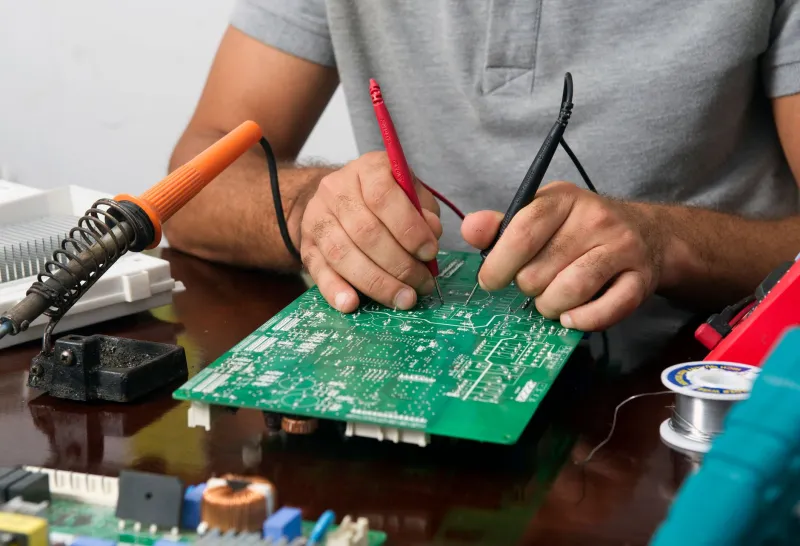
Photo by Photo by Alexandre Debiève on Unsplash on Unsplash
The Revision That Didn't Have to Happen
A three-layer board revision. Four weeks of schedule slip. Forty thousand dollars in tooling, fabrication, and engineering time. The cause: a firmware team that identified a DMA channel conflict six weeks after the layout was released to manufacturing—a conflict that required rerouting two SPI buses, reassigning eight GPIO pins, and adding a pull-up network that the original design had no room for.
This scenario is not unusual. It is, in fact, depressingly common across American electronics development programs. The root cause is not incompetence on either team. It is a structural assumption embedded in many development processes: that hardware and firmware can be designed in parallel with minimal interaction until integration begins.
That assumption is wrong, and the revision cycle is the invoice.
Why the Hardware-Firmware Interface Is More Complex Than It Appears
At first glance, the interface between hardware design and firmware seems straightforward. The schematic defines the signals; the firmware reads and writes them. But the actual dependency structure is considerably more intricate.
Firmware requirements drive hardware decisions at multiple levels. Peripheral selection determines which microcontroller features must be physically accessible—and physical accessibility is a layout constraint, not just a schematic one. Interrupt latency requirements influence decoupling strategy and clock distribution design. Boot sequence dependencies determine which signals must be in defined states at power-on, which in turn affects pull-up and pull-down resistor placement. Real-time operating system timing constraints can determine whether a design needs a dedicated oscillator or can share a clock source—a decision with board-level footprint implications.
None of these dependencies are visible in the schematic alone. They exist in firmware architecture documents, interrupt priority tables, peripheral driver requirements, and the tacit knowledge of software engineers who have not yet been asked the right questions.
The Failure Modes That Reveal the Gap
Firmware-hardware conflicts manifest in several characteristic patterns, each with a distinct cost profile.
Pin function conflicts occur when a firmware team discovers that the microcontroller peripheral assigned to a function in the schematic shares hardware resources with another required peripheral. A UART and an SPI bus that share a DMA channel cannot operate simultaneously at the required throughput—and if the layout has already been completed around that peripheral assignment, the fix requires both schematic changes and layout rework.
Timing violations emerge when firmware developers determine that a signal path has more propagation delay than the peripheral's setup and hold time requirements permit. This is particularly common in high-speed memory interfaces, where layout decisions about trace length matching and via placement directly affect signal timing—and where firmware developers often discover the problem only when running actual code on prototype hardware.
Boot sequence incompatibilities arise when hardware designers make reset circuit or power sequencing decisions without understanding the firmware's initialization order. A processor that requires a specific peripheral to be in a known state before its boot ROM runs can be rendered non-functional by a power sequencing decision that seemed entirely reasonable from a hardware perspective.
Interrupt priority exhaustion occurs when the firmware team maps all required interrupt sources and discovers that the hardware configuration has not preserved sufficient interrupt lines or has routed interrupt-capable signals to non-interrupt-capable pins.
Extracting Firmware Constraints Before They Become Problems
The solution is not to wait for firmware to be complete before beginning hardware design. That would serialize a process that must remain parallel to meet competitive time-to-market demands. The solution is structured, early extraction of the firmware constraints that have hardware implications—before those implications become expensive.
The following checklist represents the minimum firmware intelligence that hardware teams should capture before finalizing a schematic, let alone a layout.
Peripheral utilization map: Which microcontroller peripherals does the firmware require, and which physical pins must they occupy? This includes primary assignments and any fallback configurations.
DMA channel allocation: Which peripherals require DMA, and which DMA channels are assigned? DMA channel conflicts are among the most common sources of last-minute hardware revision.
Interrupt requirements: Which signals require interrupt capability? What are the interrupt priority assignments, and are there any timing constraints on interrupt latency that affect hardware design?
Clock requirements: What clock sources does the firmware require, and what are the accuracy and stability specifications? Does any firmware module require a dedicated clock source independent of the main system clock?
Boot and reset dependencies: What is the required power-on state of each peripheral? What is the reset sequence, and what hardware signals must be in defined states before the processor begins executing?
Timing-sensitive interfaces: Which data interfaces have setup and hold time requirements that translate into trace length or propagation delay constraints? This is particularly critical for memory buses, high-speed serial interfaces, and sensor data paths.
GPIO state at power-on: Which GPIO pins must be in specific states at power-on before firmware can configure them? This determines pull-up and pull-down requirements that cannot be added after layout completion.
Structuring the Cross-Functional Design Review
Capturing firmware constraints requires a structured review process, not an informal conversation. Informal conversations produce incomplete information because neither party knows exactly what questions to ask.
A firmware-hardware alignment review, conducted before schematic finalization and again before layout release, should include the following elements.
A hardware team representative presents the proposed peripheral assignment map and requests confirmation from the firmware team. The firmware team reviews the map against their peripheral driver requirements and interrupt assignments. Any conflicts are logged and resolved before the review closes.
The firmware team presents their DMA allocation plan and clock requirements. The hardware team confirms that the physical implementation supports those requirements, including any layout implications for signal routing.
Both teams review the power-on and reset sequence against the hardware power delivery architecture. Any dependencies that require hardware changes are identified and prioritized.
The output of each review is a documented constraint register—a living document that records every firmware requirement with hardware implications, the hardware decision made to address it, and the responsible owner on each team. This document becomes the reference for any subsequent design change and the first place to look when a conflict surfaces during integration.
The Cost Arithmetic of Early Collaboration
The investment required for structured firmware-hardware alignment reviews is modest. A two-hour review with four to six participants, conducted twice during the design cycle, represents perhaps twenty person-hours of engineering time.
The cost of a board revision driven by a firmware-hardware conflict that those reviews would have caught is rarely less than thirty thousand dollars when tooling, fabrication, engineering rework, and schedule impact are fully accounted for. In complex programs, revision costs exceed six figures.
The arithmetic is not ambiguous. Early collaboration is not a process overhead. It is a cost avoidance mechanism with a return on investment that is difficult to overstate.
Building the Habit Across the Organization
The deeper challenge is cultural. Hardware and firmware teams in many American electronics organizations have historically operated as parallel tracks that converge at integration. That model made more sense when hardware was simpler and firmware was thinner. Modern embedded systems, with complex peripheral interactions, real-time operating system dependencies, and high-speed interface requirements, have made the old model structurally inadequate.
Organizations that build structured firmware-hardware alignment into their standard development process—not as an exception for complex programs, but as a routine expectation for every board development—consistently report fewer revision cycles, shorter integration timelines, and higher first-pass success rates.
At PCBs Inv, the principle is direct: the firmware your board will run is part of its design specification. Treat it that way from the first schematic, and the manufacturing floor will thank you.