Deadline or Design: How Shrinking PCB Lead Times Are Forcing American Hardware Teams to Choose
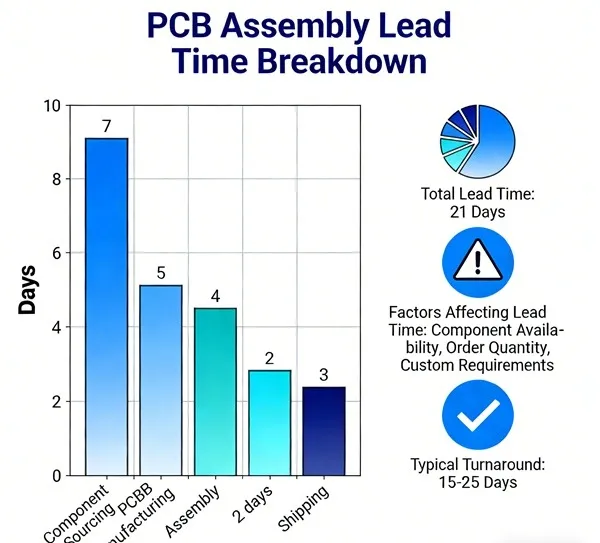
Photo: PCB manufacturing factory production line lead time schedule planning, via topfastpcba.com
There is a particular kind of pressure that every hardware program manager in America knows intimately. It arrives not as a single catastrophic event but as a slow accumulation of calendar slippage, supplier delays, and internal revision cycles — until one morning, the launch date is immovable and the board is still not ready. What happens next defines whether a product succeeds or quietly fails in the field.
For a growing number of American electronics companies, that moment is arriving earlier in the product cycle than ever before. PCB lead times, long treated as a fixed variable in project planning, have become one of the most unpredictable elements in modern hardware development. And the consequences of underestimating them are no longer confined to missed deadlines. They are being written into the design itself.
The Bottleneck Nobody Planned For
The structural reasons behind US PCB capacity constraints are not new, but their compounding effect has intensified. Domestic fabrication capacity never fully recovered from the offshoring wave of the late 1990s and early 2000s. What remains is a network of capable but often oversubscribed manufacturers, concentrated in a handful of states, serving a demand base that has expanded considerably in the wake of post-pandemic reshoring initiatives.
At the same time, the complexity of modern boards has increased dramatically. High-density interconnect designs, advanced materials for high-frequency applications, and increasingly tight impedance tolerances all require fabrication steps that take time — time that cannot simply be compressed by adding a shift or expediting a work order. When a fabricator's capacity is already stretched, the premium for speed becomes extraordinary, and not every company can absorb it.
The result is a two-tier market. Large-volume customers with long-standing supplier relationships can often negotiate predictable lead times. Smaller firms, startups, and mid-market hardware developers are left navigating a spot market where a six-week lead time can become ten weeks with little warning.
When Time Pressure Becomes a Design Decision
The most damaging consequence of compressed lead times is not the delay itself. It is what engineers do in response to the delay.
Consider a scenario that has played out repeatedly across American hardware development programs: A board is in its second revision. Testing has revealed a thermal management issue that requires rerouting several power planes and repositioning a component cluster near the edge of the board. The correct fix is well understood. But making that change means ordering a new fabrication run, and the current supplier is quoting eight weeks. The launch window closes in six.
In that moment, the engineering team faces a choice that is framed as a scheduling problem but is actually a reliability decision. Some teams apply a partial fix — one that addresses the most visible symptom without resolving the underlying cause. Others freeze the design and accept known limitations, documenting them as acceptable risk. In both cases, the product that reaches customers carries a compromise that originated not in the engineering process but in the supply chain.
These are not hypothetical outcomes. Field return data from consumer electronics and industrial control systems consistently reveals failure modes that trace back to design decisions made under timeline pressure. The solder joint that cracks under thermal cycling, the power rail that sags under load, the impedance mismatch that degrades signal quality at operating frequency — each of these can originate in a revision that was never made because the lead time made it impossible.
The Hidden Cost of the Expedite
For companies with the budget to pursue it, expedited fabrication appears to solve the problem. Pay the premium, compress the timeline, keep the launch date intact. But the economics of the expedite are rarely as straightforward as they appear.
Expedited fabrication typically involves a fabricator prioritizing one customer's job over others, often by running smaller panel sizes, dedicating equipment exclusively to a single order, or pulling staff from standard-queue work. These adjustments introduce variability. Process parameters that are well-optimized for standard production runs may drift slightly when applied under compressed conditions. Inspection cycles may be abbreviated. The risk of subtle defects — plating voids, registration errors, laminate inconsistencies — increases in proportion to the speed of production.
Engineers who have spent months optimizing a design for manufacturability may find that the expedited board they receive does not behave identically to the prototype built under standard conditions. This is not a condemnation of domestic fabricators, most of whom maintain rigorous quality standards even under pressure. It is a recognition that speed and consistency exist in genuine tension, and that the expedite premium does not always purchase the certainty it appears to offer.
Building a Timeline That Accounts for Reality
The most effective response to lead time volatility is not to accept it as an immutable constraint but to engineer around it from the earliest stages of a program.
Several practices have proven consistently effective for US-based hardware teams navigating this environment.
Front-load fabrication conversations. Engaging a fabrication partner at the schematic phase — rather than at the point of Gerber release — allows engineers to understand lead time realities before they become critical path items. A fabricator who knows what is coming can often reserve capacity that would otherwise be unavailable.
Design for the supply chain you have, not the one you want. Boards that require exotic materials, unusual stack-up configurations, or exceptionally tight tolerances will always command longer lead times. Where performance requirements allow flexibility, choosing materials and configurations that align with a fabricator's standard process can significantly reduce turnaround time without compromising reliability.
Build revision cycles into the schedule explicitly. Many program plans treat PCB revisions as contingencies — events that may or may not occur. In practice, revision cycles are nearly universal. Treating them as planned events, with associated lead time allocations, converts a common source of schedule disruption into a managed phase of development.
Establish relationships with multiple fabrication partners. Single-source dependence amplifies the impact of any individual supplier's capacity constraints. Maintaining qualified relationships with two or more fabricators — including at least one with rapid-turn capability — provides a buffer that pure cost optimization cannot.
The Strategic Dimension
Beyond individual program management, the lead time problem reflects a broader structural challenge for American electronics competitiveness. The reshoring initiatives that have gained momentum since 2020 have not yet produced the domestic fabrication capacity needed to serve a market that has grown considerably more complex and more demanding.
For engineering teams, this means that supply chain awareness is no longer a procurement function that operates downstream of design. It is a design input, as consequential as thermal analysis or signal integrity modeling. The board that gets built on time and performs reliably in the field is increasingly the one whose designers understood the manufacturing environment before they placed the first component.
At PCBs Inv, we have observed this shift across the programs and companies we cover. The engineers who navigate lead time pressure most successfully are not those who find ways to go faster. They are those who build enough intelligence about the manufacturing environment into their process that speed is rarely required.