Design for the Factory Floor: Why Your Earliest PCB Decisions Determine Your Production Launch Date
There is a particular kind of frustration that every electronics program manager knows. The prototype works. The engineering team is confident. The customer is waiting. And then, somewhere between the design freeze and the first production build, the schedule begins to slip—one design revision at a time, one component substitution at a time, one manufacturing exception at a time—until what was supposed to be a twelve-week ramp to volume production has consumed six months and two additional spins of the board.
This is not bad luck. It is the predictable consequence of designing a circuit board for the bench rather than for the factory floor.
The argument here is direct: the design decisions that most profoundly affect a manufacturing timeline are made during the earliest phases of development, often before a single component has been soldered. Engineering teams that internalize this reality—and structure their design process accordingly—launch products faster, spend less on redesigns, and build supply chains that hold up under pressure. Those that do not will keep learning the same expensive lessons.
The Prototype Trap
Prototyping is, by its nature, an exercise in controlled compromise. Engineers reach for the components that are available in their laboratory, the footprints that are already in their library, and the stackup that their contract manufacturer can turn around in forty-eight hours. These choices make perfect sense in the context of proving a concept. They become serious liabilities the moment a design moves toward production intent.
Consider component selection. A prototype built around a microcontroller that happens to be in stock at a local distributor may sail through functional validation. But if that part is sourced from a single manufacturer with a twelve-week lead time and no pin-compatible alternative, the production program is now hostage to a supply chain decision made during breadboarding. The component works electrically. It simply cannot be sourced at volume, on schedule, at a price that supports the product's margin targets.
This scenario plays out across every component category. Passive components specified in non-standard package sizes. Connectors from vendors with limited US distribution. Memory devices that are technically available but allocated to larger customers during periods of constrained supply. Each of these choices, made individually for defensible reasons, accumulates into a sourcing risk profile that procurement teams inherit without warning.
Layer Stackup: A Decision With Long Reach
Of all the early design decisions that affect manufacturability, layer stackup selection is among the most consequential—and the most difficult to reverse once the design has matured.
A stackup chosen without input from the intended contract manufacturer may meet signal integrity requirements on paper while creating practical production challenges. Asymmetric copper distribution generates bow and twist during lamination, complicating pick-and-place accuracy and potentially causing solder joint defects at reflow. Non-standard dielectric thicknesses extend fabrication lead times because they require custom material orders rather than standard shop stock. Impedance targets that are theoretically achievable but sit at the edge of a fabricator's process capability will generate yield losses that inflate unit costs and compress delivery windows.
Engineering teams that engage their manufacturing partners during stackup definition—before routing begins—consistently avoid these problems. The conversation is straightforward: here are the signal integrity requirements, here are the layer count constraints, here is the target fabricator. What stackup geometry can you build reliably, at volume, within standard lead times? That exchange, which takes perhaps two hours at the start of a project, can save two weeks at the end of it.
Manufacturability Compliance Is Not a Final Step
Design for Manufacturability (DFM) review is frequently treated as a gate that occurs after the layout is complete—a checklist exercise performed by the contract manufacturer before they agree to quote the job. This sequencing is backwards, and it is one of the primary reasons that first-article builds generate long lists of engineering queries and deviation requests.
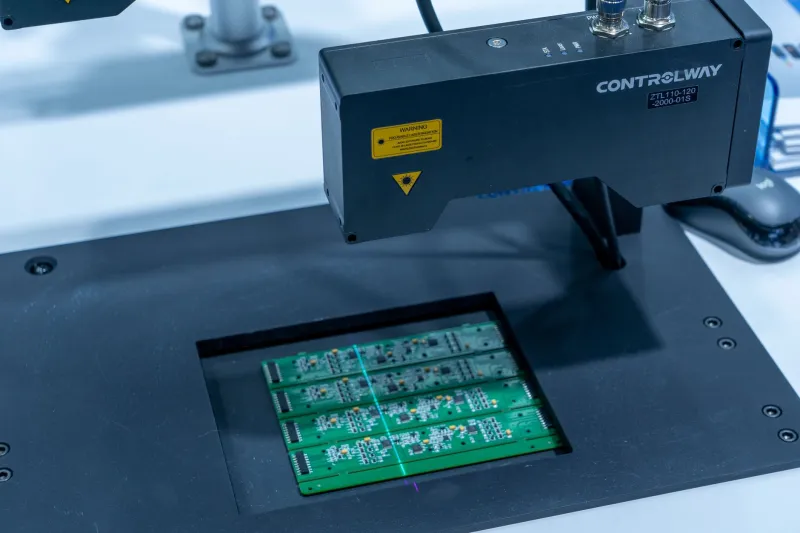
DFM principles should inform layout decisions from the first placed component. Courtyard clearances that accommodate the assembly equipment at the intended manufacturer. Fiducial markers positioned to support automated optical inspection. Test point coverage that allows in-circuit test without requiring bed-of-nails fixtures to be redesigned between prototype and production. Panelization-friendly board outlines that minimize material waste and simplify depaneling.
None of these considerations are technically complex. They require knowledge of the manufacturing environment, consistent application of design rules, and the discipline to prioritize producibility alongside electrical performance. What they do not require is waiting until the layout is complete to think about them.
The Component Availability Reckoning
The supply chain disruptions of the early 2020s forced American electronics manufacturers to confront a vulnerability that had been building for decades: deep dependence on single-source components, extended lead times, and offshore supply chains with limited resilience. Many programs that were designed before those disruptions embedded assumptions about component availability that simply no longer held.
The lesson has not been uniformly absorbed. Design teams still routinely specify components without verifying multi-source availability, without confirming that preferred alternatives share identical footprints, and without establishing a sourcing strategy before the bill of materials is locked. When a key component goes on allocation six weeks before a production launch, the result is a choice between delaying the program or accepting an alternative that requires a board respun.
A production-first design mindset treats component sourcing as a design constraint, not a procurement afterthought. It means checking distributor stock levels and lead times during component selection, not after. It means specifying parts with at least two qualified sources wherever possible. It means maintaining a preferred parts list that reflects what is actually available in the US market, updated regularly, and used as the starting point for new designs rather than an aspirational reference document.
Arguing for the Production-First Philosophy
The counterargument to production-first design is familiar: moving fast in the prototype phase requires flexibility, and imposing manufacturing constraints too early slows the iteration cycle. There is some validity to this position. Rigid adherence to production design rules during early feasibility exploration can impede the creative problem-solving that good engineering requires.
But the inflection point comes sooner than most teams acknowledge. By the time a design has been through two functional prototypes and is approaching design freeze, the cost of late-stage manufacturability problems vastly outweighs the cost of the earlier constraints. A design revision at that stage does not affect one engineer's schedule—it affects procurement, program management, customer commitments, and potentially regulatory re-qualification.
American electronics firms competing in global markets do not have the luxury of extended redesign cycles. Domestic manufacturing, which carries real cost advantages in supply chain resilience and time-to-market for US customers, cannot absorb the schedule penalties that come from designs that were never intended to be manufactured at volume. The firms that will compete most effectively over the next decade are those that treat the factory floor as a design requirement from day one—not as an obstacle to be negotiated at the end.
What the First Design Review Should Cover
If a production-first mindset is to be operationalized rather than merely advocated, it needs to show up in process. The first formal design review on any new PCB program should include, at minimum, a stackup discussion with the intended fabricator, a component sourcing risk assessment from procurement, a DFM checklist review against the contract manufacturer's capabilities, and a panelization concept.
These are not burdensome additions to the engineering process. They are investments that pay returns at every subsequent phase of development. The teams that build these habits into their standard workflow are the ones that hit their production launch dates—and in a competitive market, that is an advantage that compounds over time.