Every Change Has a Price Tag: The True Financial Weight of Mid-Stage PCB Design Modifications
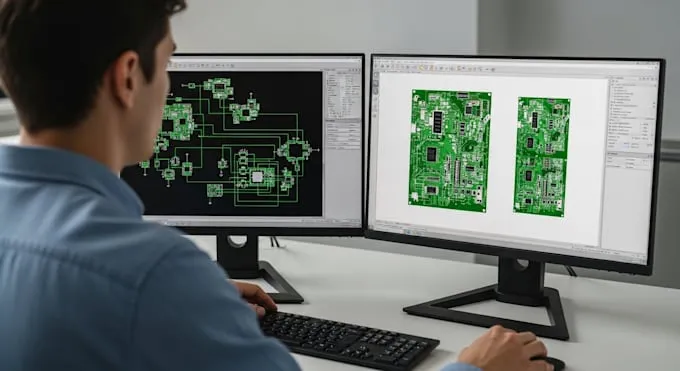
Photo: engineer reviewing PCB design schematic at workstation with circuit board and cost documents, via fiverr-res.cloudinary.com
In PCB development, no decision exists in isolation. Every component placement, every trace route, and every layer stack-up choice reverberates outward into procurement timelines, tooling configurations, regulatory schedules, and ultimately, the bottom line. Yet many electronics firms—particularly those operating at the small to mid-sized scale—continue to treat design iteration as an acceptable cost of doing business rather than a financial risk to be actively managed.
The reality is considerably more sobering. Mid-stage engineering change orders, commonly referred to as ECOs, do not simply consume engineering hours. They trigger cascading financial effects across multiple departments simultaneously, compressing margins and threatening launch windows in ways that even experienced program managers frequently fail to anticipate until the invoices arrive.
The Deceptive Simplicity of an ECO
On the surface, an engineering change order looks manageable. A component is substituted. A trace is rerouted. A connector is repositioned to accommodate a revised mechanical housing. The schematic is updated, the layout is adjusted, and the revision is logged. Many teams treat this sequence as a standard workflow event rather than a financial trigger.
What that view misses is the downstream blast radius. A single component substitution, for example, may invalidate an existing component qualification report, require updated impedance modeling, force a re-spin of the fabrication data package, and necessitate a new round of prototype builds before production approval can be granted. Each of those steps carries a direct cost. Collectively, they can easily multiply the apparent cost of a minor revision by a factor of five to ten.
For a company operating on a product development budget of $200,000 to $500,000—a common range for mid-market electronics manufacturers in states like Texas, Ohio, and Michigan—a single late-stage ECO that triggers a full prototype re-spin can consume fifteen to twenty percent of that budget in a matter of weeks.
Where the Money Actually Goes
Breaking down the financial anatomy of a late-stage design change reveals several distinct cost centers that often go untracked in aggregate.
Tooling and Fabrication Rework. Once a PCB design has progressed to the point where fabrication data has been generated and submitted, any significant modification requires a complete regeneration of Gerber files, drill files, and fabrication notes. If the change affects layer stackup or copper weight, new laminate material may need to be specified and sourced. Custom stencils for solder paste application must be remade. In high-volume production environments, tooling costs alone for a single re-spin can range from $3,000 to $15,000 depending on board complexity and layer count.
Inventory Obsolescence. Components ordered in anticipation of a production run do not simply disappear when a design change makes them unnecessary. Depending on the terms negotiated with distributors, obsoleted inventory may be non-returnable. A Rochester, New York-based contract manufacturer interviewed for this analysis reported writing off approximately $28,000 in component inventory following a late-stage connector change on a medical device project—a cost that was entirely absent from the original ECO impact assessment.
Certification and Compliance Delays. For products subject to regulatory approval—whether FCC certification for wireless devices, UL listing for power electronics, or FDA clearance for medical equipment—any substantive design modification after testing has begun may require partial or complete re-testing. The cost of a single FCC pre-compliance test session at an accredited laboratory can range from $5,000 to $20,000. More significantly, the scheduling delay associated with re-testing can push a product launch by six to twelve weeks, a timeline impact that carries its own revenue consequences in competitive market segments.
Engineering Labor Compounding. The direct labor cost of implementing an ECO is typically the first figure cited when teams estimate change impact. It is also typically the most understated. Beyond the hours required to update the schematic and layout, teams must re-verify signal integrity, re-run thermal simulations, update the BOM, revise the assembly drawing package, and update design history documentation. When those activities are distributed across multiple engineers and reviewed by program management, the actual labor investment frequently exceeds initial estimates by a factor of two or three.
A Case Study in Compounding Costs
Consider a mid-sized industrial controls manufacturer based in the Midwest that was developing a motor controller PCB for an automated manufacturing application. Midway through the layout phase, a mechanical redesign of the enclosure required repositioning the main power connector. The engineering team estimated the change would require approximately sixteen hours of layout revision and one additional prototype build.
The actual outcome was considerably different. Repositioning the connector altered the power plane geometry, which required a full re-analysis of current carrying capacity and thermal distribution. The revised thermal profile pushed the operating temperature of a nearby voltage regulator above its rated maximum, necessitating a component substitution. That substitution required updated decoupling capacitor values, which in turn affected the power supply noise floor and required re-validation of the control signal integrity. The project ultimately required two additional prototype builds, a new set of custom stencils, and a six-week delay to the planned UL testing schedule.
Total unplanned expenditure: approximately $67,000. Original ECO estimate: $4,200.
Designing Against Iteration
The most effective strategy for controlling design change costs is not faster ECO processing—it is reducing the frequency and severity of changes through more rigorous upfront validation. Several practices have demonstrated consistent value in this regard.
Concurrent mechanical and electrical design. Many late-stage PCB changes originate from mechanical packaging decisions made independently of the electrical design. Establishing shared design reviews that include both mechanical and electrical engineers early in the development cycle significantly reduces the likelihood of connector repositioning, board outline changes, and keep-out zone conflicts arising after layout has progressed.
Pre-layout signal integrity and power integrity simulation. Investing in simulation tools that can evaluate signal behavior and power distribution before the full layout is completed allows teams to identify problematic topologies and component placements before they become embedded in fabrication-ready data. The cost of simulation software and engineering time is almost always less than the cost of a single prototype re-spin.
Component selection with production readiness criteria. Many ECOs are driven by component availability issues discovered after design completion. Establishing a component selection protocol that evaluates lifecycle status, multi-source availability, and distributor stock levels at the schematic stage—rather than during BOM finalization—eliminates a significant proportion of substitution-driven changes.
The Organizational Dimension
Beyond individual project economics, the cumulative effect of frequent design iteration shapes organizational capacity in ways that are difficult to measure but genuinely significant. Engineering teams that spend substantial time processing ECOs have less capacity for new product development. Program managers who regularly absorb unplanned cost overruns develop conservative budgeting habits that can constrain investment in genuinely innovative projects.
For American electronics manufacturers competing against offshore producers with lower labor and overhead costs, the efficiency advantage of disciplined design practice is not merely financial—it is strategic. Reducing iteration costs is one of the clearest paths to protecting margin, accelerating time to market, and sustaining the kind of engineering velocity that supports long-term competitiveness.
The circuit board itself may be the product. But the process that produces it is the business. Protecting one means investing seriously in the other.