The Legitimate Teardown: A Structured Approach to Competitive PCB Analysis Within Ethical and Legal Boundaries

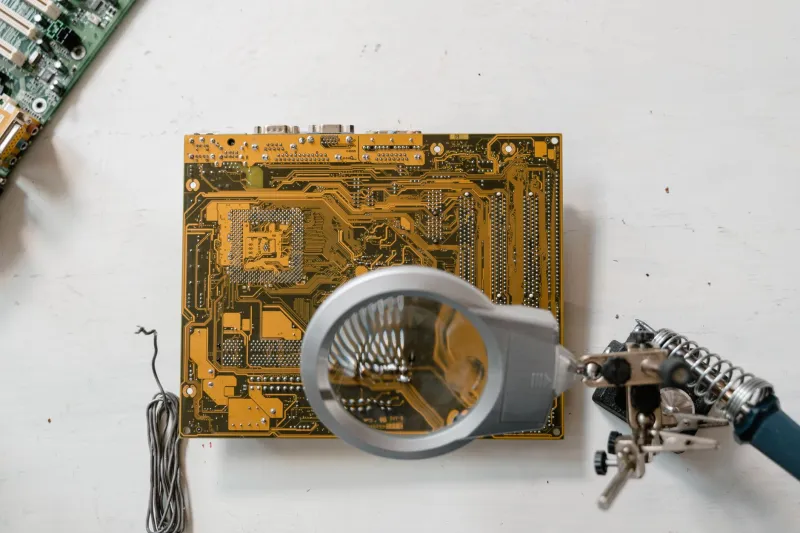
Photo by Photo by Zan Lazarevic on Unsplash on Unsplash
Why Engineers Are Leaving Intelligence on the Table
Every commercially available electronic product contains a PCB that somebody designed, somebody built, and somebody paid to have tested. That board encodes decisions—about layer stackup, component selection, routing strategy, power delivery architecture, and thermal management—that reflect real engineering tradeoffs made by real teams solving real problems.
For competing design teams, that board is a primary source document. Yet many American electronics companies treat competitive teardown analysis as legally ambiguous territory best avoided entirely, or as an informal activity conducted without methodology and therefore without consistent value.
Both positions leave significant intelligence uncaptured. Legitimate reverse-engineering and competitive benchmarking are established, legally defensible practices when conducted within appropriate boundaries. The key word is legitimate—and understanding what that means in practice is the first step toward building a teardown program that informs your next design without exposing your organization to liability.
Understanding the Legal Framework
In the United States, the legal foundation for reverse-engineering rests primarily on trade secret law, patent law, and contract terms. The good news for engineering teams is that reverse-engineering a lawfully purchased commercial product is generally permissible under federal law and has been consistently upheld in court decisions including Sega v. Accolade and Sony Computer Entertainment v. Connectix.
The boundaries that matter are these:
Trade secrets are protected regardless of whether a product is publicly sold. If a competitor's board contains a proprietary process, material, or architecture that cannot be discerned through visual or analytical inspection without misappropriation of confidential information, that protection survives the product's commercial availability. In practice, most PCB design decisions are discernible through legitimate analytical means and do not carry trade secret protection.
Patents protect specific claims. A teardown that reveals a patented topology or component arrangement does not grant a license to implement it. Teardown analysis must feed into design inspiration and problem-framing, not direct replication of patented approaches.
End-user license agreements and terms of sale occasionally contain prohibitions on reverse-engineering. These are more common in software contexts but appear in some hardware product terms. Legal review of purchase terms before initiating a formal teardown program is standard practice.
With those boundaries understood, the space for legitimate competitive analysis is substantial.
Building a Teardown Methodology
Ad hoc teardowns produce ad hoc insights. A structured program produces actionable intelligence that feeds directly into design decisions. The methodology described here has been refined across industrial, communications, and consumer electronics benchmarking programs.
Step One: Define the Analytical Objectives
Before purchasing a single unit, the team should articulate what questions the teardown is designed to answer. Unfocused teardowns generate observations without conclusions. Focused teardowns generate answers.
Typical objective categories include: How does the competitor manage thermal dissipation in a constrained form factor? What signal integrity strategy does their high-speed interface layout employ? How do they approach power rail decoupling at the component level? What layer count and stackup configuration supports their operating frequency? How do they achieve their published EMI compliance margins?
Defining objectives determines what analytical tools and expertise are required and prevents the team from spending three days documenting features that have no bearing on the design questions at hand.
Step Two: Acquire Units Through Legitimate Channels
Purchase units through standard commercial channels—retail, distribution, or authorized resale. Document the purchase. This establishes the chain of lawful acquisition that underlies the legal permissibility of the analysis. Do not acquire units through channels that involve misrepresentation, theft, or breach of confidentiality agreements.
For high-volume benchmarking programs, acquiring multiple units supports statistical analysis of manufacturing variation and allows destructive and non-destructive analysis to proceed in parallel.
Step Three: Non-Destructive Analysis
Begin with the information available without physical disassembly. Visual inspection of the exterior, connector configurations, form factor, and thermal management features (heat spreaders, vents, external heatsinks) establishes the mechanical architecture. Photography under controlled lighting conditions creates a reference record.
X-ray fluorescence (XRF) analysis identifies surface material composition without destructive sampling. X-ray imaging reveals internal layer routing patterns, via structures, and component placement density without delamination. These techniques are available through third-party analytical laboratories and are entirely legitimate.
Step Four: Board-Level Disassembly and Documentation
With the product disassembled, systematic photography of both board sides under magnification establishes the visual record. Component identification—by marking, package, and placement context—proceeds in parallel. Many components can be identified from visible markings; others require cross-referencing with distributor databases or datasheet libraries.
Layer count estimation from board edge examination, combined with thickness measurement, provides stackup data. Cross-section analysis through controlled board sectioning reveals actual layer configuration, copper weight, via aspect ratios, and laminate material characteristics. Cross-section analysis is the most destructive step and should be reserved for a dedicated unit.
Step Five: Feature-by-Feature Architecture Comparison
With the board fully documented, structured comparison against your own design architecture begins. A feature comparison matrix maps specific design decisions against your current approach and identifies gaps, alternatives, and potential improvements.
For signal integrity, compare trace routing strategies, via usage near high-speed interfaces, reference plane continuity, and differential pair management. For thermal management, compare copper pour strategy, thermal via placement, component orientation relative to airflow, and heatsink attachment methods. For power delivery, compare decoupling capacitor placement, bulk capacitance sizing, and power plane segmentation.
The output is not a blueprint for replication. It is a structured record of how a competitor solved specific engineering problems—input to your own design process, not a substitute for it.
Cost Modeling Insights From Teardown Data
Board-level analysis yields cost intelligence that complements the design insights. Component identification feeds into cost modeling: what is the bill-of-materials cost structure of the competitor's design? Where have they made cost-reduction decisions that sacrifice performance margin, and where have they invested in premium components that explain their price positioning?
Layer count, board area, and surface finish identification provide manufacturing cost proxies. A competitor operating at six layers in a form factor you currently achieve at eight layers has either found a more efficient stackup or accepted a performance tradeoff—and understanding which is strategically valuable.
Ethical Boundaries That Protect Your Organization
Beyond legal compliance, a teardown program with clear ethical boundaries produces more defensible and more credible outputs. Several principles apply consistently.
Do not attempt to identify or exploit manufacturing defects in ways that could be used to disparage competitors. Do not use teardown intelligence to make false claims about competitor products. Do not share teardown findings with parties who might misuse them or whose access creates legal risk. Document the analytical methodology so that the process is transparent and reproducible.
When teardown intelligence feeds into design decisions, document the connection clearly—not to expose the source, but to ensure that the design team understands the origin of specific insights and can evaluate them appropriately.
Translating Benchmarks Into Better Designs
The ultimate measure of a teardown program is whether it makes your next board better. Intelligence that sits in a report without influencing design decisions has no return on investment.
The most effective programs integrate teardown findings into design review processes, use them to challenge assumptions about what is achievable within cost and form factor constraints, and treat them as one input among several—alongside simulation results, customer feedback, and manufacturing process data.
At PCBs Inv, competitive intelligence is most valuable when it asks better questions of your own design process. The competitor's board does not tell you what to build. It tells you what is possible—and that is exactly the right place to start.